
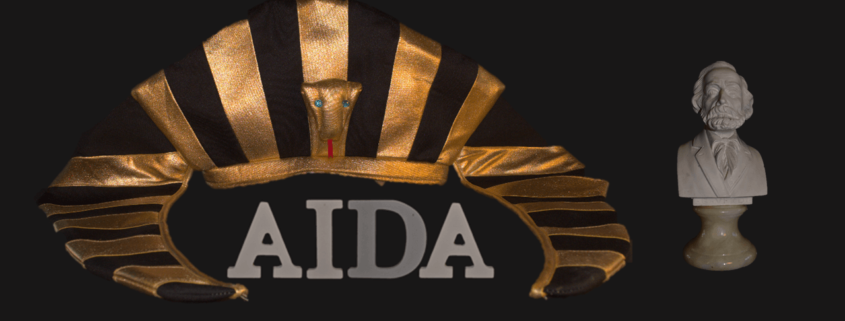
The Synopsis and Libretto to AIDA
Get to know the Synopsis of the opera AIDA by Giuseppe Verdi. In a 4-minute film you will watch the most important actions. Enriched with role descriptions and informative illustrations.
OVERVIEW & DIRECT ACCESS
Content
♪ Synopsis in 4 minutes - YouTube Video
♪ Link to the opera portraits (with interesting informations, and great Youtube Videos)
♪ Top 5 Highlights of the opera
Libretto
♪ Act I (Palace-Scene, Tempel-scene)
♪ Act II (Victory-scene)
♪ Act III (Nile-scene)
♪ Act IV (Judgement-scene, Death-scene)
The Synopsis of AIDA in 4 minutes
Relationsship diagram of main roles
The blogpost to the opera
Hear and read interesting facts and great YouTube Videos to AIDA in a comprehensive Blogpost
The written Synopsis
The Roles
Aida, Slave at the egytian court and daugther of King Amonasro
Amonasro, King of Ethiopia
The pharao, King of Egypt
Amneris, Daughter of the pharao
Radames, Warrior
Synopsis
Aida, the daughter of the Ethiopian king Amonasro is a slave at the Egyptian court. The Ethiopian warriors attack Egypt to free Aida. Radames, Aida’s secret lover, is appointed commander of the Egyptians. Aida is torn between her love for her fatherland and Radames. Aida is Amneris’ slave who is the Pharao’s daughter and also is in love with Radames. The Egyptians can defeat the attackers. Amneris orders Aida to accompany them to the Victory Festival. There Radames is celebrated and the captured Egyptians are presented. Amonasro, disguised as an officer, is the spokesman of the defeated Ethiopians. The attackers can return. Only Aida and Amonasro are held hostage. The pharaoh grants Radames his daughter as a wife.
Amneris is praying in a Nile temple on the eve of the wedding. Aida secretly waits there for Radames. Amonasro suddenly appears and wants Aida ask Radames a war secret. Amonasro invokes her sense of duty. But Aida refuses. Amonasro hides as Radames appears. Aida proposes Radames to flee with her to Ethiopia and asks for an unguarded path. Amonasro hears Radames tell the secret way. Amonasro steps forward and Radames realizes that he has unintentionally betrayed his fatherland. So Radames must flee. At this moment Amneris steps forward and accuses him of betrayal. Amonasro wants to kill her, but Radames prevents this, but is captured. Aida and her father escape.
Radames, awaiting his trial, has lost his courage because he thinks Aida was killed during the escape. Amneris offers him throne and marriage but Radames rejects. He is sentenced to death by being walled in in the pyramid vault. Once there he meets Aida, who has sneaked into the pyramid to die with him. Together they say goodbye to the world.
The top 6 highlights of AIDA
Se quel guerriero io fossi…Celeste Aida (1) - Björling
Triumphal march - Abbado
O patria mia - Price
Ciel…mio Padre - Callas / Gobbi
E in poter di costor io lo gettai - Verrett
O terra addio - Milanov/Björling
Libretto of Aida by Giuseppe Verdi
AIDA ACT I
Hall in the Palace of the King at Memphis.—To the right and left a Colonnade with statues and flowering shrubs.—At the back a grand gate, from which may be seen the temples and palaces of Memphis, and the Pyramids.
Radames and Ramphis.
Ramphis.
Yes, it is rumored that the Ethiop dares once
Again our power in the valley of Nilus,
Threaten as well as Thebes. The truth from
Messengers I soon shall know.
Radames.
Hast thou consulted
The will of Isis?
Ramphis.
She has declared
Who of Egypt’s renowned
Armies shall be leader.
Radames.
Oh, happy mortal!
Ramphis.
(Looking significantly at Radames.)
Young in years is he and dauntless.
The dread commandment I to the king shall take.
(Exit.)
Radames.
What if ’tis I am chosen,
Ah my dream be now accomplished!
Of a glorious army
I the chosen leader—mine glorious victory—
By Memphis received in triumph
To thee returned, Aida, my brow entwined with laurel—
Tell thee, for thee I battled, for thee I conquered!
Heav’nly Aida, beauty resplendent,
Radiant flower blooming and bright;
Queenly thou reignest o’er me transcendent,
Bathing my spirit in beauty’s light.
Would that thy bright skies once more beholding,
Breathing the soft airs of thy native land;
Round thy fair brow a diadem folding,
Thine were a throne next the sun to stand.
SCENE II.
Amneris and the same.
Amneris.
In thy visage I trace a joy unwonted!
What martial ardour is beaming in thy noble glances!
Ah me! how worthy were of all envy the woman whose dearly wish’d-for presence
Could have power to kindle in thee such rapture!
Radames.
A dream of proud ambition
In my heart I was nursing—Isis this day
Has declared my name the warrior chief appointed
To lead to battle Egypt’s hosts,—ah, for this honour
Say what if I were chosen!
Amneris.
Has not another vision,
One more sweet, more enchanting,
Found favour in your heart? Is there in
Memphis no attraction more charming!
Radames.
I!—(fatal question!)
(Has she the secret yearning
Divined within me burning!
Have then these eyes betrayed me
And told Aida’s name!)
Amneris.
(Ah woe, my love if spurning
His heart to another were turning,
Woe if hope should false have played me,
And bootless prove my flame!)
SCENE III.
Aida and the same.
Radames.
(Seeing Aida approaching.)
Aida!
Amneris.
(He is troubled—ne’er lover
Gazed with more raptured eyes!
Aida! should I discover
One who with me now vies?)
(After a short pause turning to Aida.)
Come hither, thou I dearly prize—
Slave art thou none, nor menial,
Here have I made by fondest ties
Sister, a name more genial,
Weep’st thou? the secret let me know
Wherefore thy tears, yes,
Wherefore thy tears now flow!
Aida.
Alas! the cry of war I hear,
Vast hosts I see assemble.
Therefore the country’s fate I fear,
For me, for all I tremble.
Amneris.
And art thou sure no deeper woe
Now bids thy tears to flow?
(Aida casts down her eyes and hides her emotion.)
(Regarding Aida.)
(Tremble, O thou base vassal!
Lest thy secret stain is detected!
All in vain thou wouldst dissemble,
By tear and blush betrayed!)
Aida.
(No! fate o’er Egypt looming
Weighs down on my heart dejected,
I wept that love thus was dooming
To woe a hapless maid.)
Radames.
(Regarding Amneris.)
(Her glance with anger flashing
Proclaims our love suspected.
Woe if my hopes all dashing,
She mar the plans I’ve laid.)
SCENE IV.
The King enters, preceded by his Guards and followed by Ramphis, his Ministers, Priests, Captains, etc., etc.—An Officer of the Palace, and afterwards a Messenger.
King.
Mighty the cause that summons
Round the king the faithful sons of Egypt.
From the Ethiop’s land a messenger
This moment has reached us, news of grave import
Brings he—be pleased to hear him!
(To an Officer.)
Bring the news-bearer forward.
Messenger.
The sacred regions of Egyptian soil
Is by Ethiops invaded, our fertile fields
Lie all devastated, destroyed our harvest!
Emboldened by so easy a victory the plundering hordes
To the Capital are marching.
All.
Presumptuous daring!
Messenger.
They are led by a warrior as fierce
As he is dauntless—Amonasro.
All.
The king!
Aida.
(My father!)
Messenger.
All Thebes has risen, and from her hundred portals
Has poured on the invader a torrent fierce
Fraught with relentless carnage.
King.
Yes, death and battle be our rallying cry!
All.
Battle! battle!
King.
And carnage, war unrelenting!
(Addressing Radames.)
Isis, revered goddess,
Already has appointed the warrior chief,
With power supreme invested—
Radames!
All.
Radames!
Radames.
Ye Gods, I thank you!
My dearest wish is crowned!
Amneris.
(Our leader!)
Aida.
(I tremble.)
King.
Now unto Vulcan’s temple,
Warrior brave, there to gird thee to victory,
Donning sacred armour.
Up! of Nilus’ sacred river
Guard the shores Egyptians brave
Unto death the foe deliver,
Egypt they never shall enslave.
Ramphis and Priests.
Glory render, glory abiding,
To our gods all mortals guiding;
Peace or war alone deciding,
Their protection let us crave.
Chorus.
Up of Nilus’ sacred river
Guard the shores, Egyptians brave,
Unto death the foe deliver:
Egypt they never shall enslave.
Radames.
Glory’s sacred thirst now claims me,
Only war alone inflames me,
On to vict’ry, naught we stay for!
Death and battle we’ll wreak on the foe!
Amneris.
(Presenting a standard to Radames.)
From my hand, thou warrior glorious,
Take thy standard aye victorious,
Let it ever lead the way
For thy opponent’s overthrow.
Aida.
(Whom to weep for? whom to pray for?
Ah! what power to him now binds me!
Doom’d to love him though all reminds
That I love my country’s foe.)
All.
Battle, battle, we’ll hunt the invader down!
On! Radames, thy brow may laurels crown!
(Exeunt, except Aida.)
Aida.
Thy brow may laurels crown! what! can my lips
Pronounce language so impious! wish him
Victor o’er my father! o’er him who wages war
But that I may be restored to my country,
To my kingdom, to the high station
I now perforce dissemble! wish him conqueror
O’er my brothers! e’en now I see him stained
With their blood so cherished, ‘mid the
Clamorous triumph of Egyptian battalions!
Behind his chariot a king, my father comes,
His fettered captive!
Ye Gods watching o’er me,
Those words deem unspoken;
A father restore me.
His daughter heart-broken;
Oh, scatter their armies,
For ever crush our foe!
What wild words do I utter? of my affection
Have I no recollection?
That sweet love that consoled me, a captive pining,
Like some bright sunny ray on my sad lot shining!
Shall I invoke destruction on the man
For whom with love I languish?
Ah! ne’er yet on this earth lived one
Whose heart was crushed beneath such anguish!
The names so holy of father, of lover,
No more dare I utter or e’en recall,
Abashed and trembling, to Heaven would hover
My prayers for both, for both my tears would fall.
Ah, woe! transformed seemed my prayers to blaspheming,
To suffer is a crime, dark sin to weep.
My senses lost, wrapt in deep night are dreaming.
To my grave would in sorrow I might creep!
Merciful Gods, look from on high!
Pity these tears hopelessly shed,
Love! mystic power, mystic and dread,
Break, break my weak heart, let me now die!
SCENE V.
Interior of the Temple of Vulcan at Memphis.—A mysterious light from above.—A long row of columns, one behind the other, vanishing in distance.—Statues of various Deities.—In the middle of the stage, above a platform covered with carpet, rises the altar, surmounted with sacred emblems.—Golden tripods emitting the fumes of incense.
Priests and Priestesses.—Ramphis at the foot of the altar.—Afterwards Radames.—The singing of the Priestesses is heard from within with harp accompaniment.
Priestesses (Within).
Hail, mighty, hail, mighty Phthà! that wakest
In all things breathing life, hail!
Lo! we invoke thee!
Hail, mighty Phtha! that makest
All fruitful things grow rife,
Lo! we invoke thee!
Flame, uncreated, eternal!
Fount of all light above,
Lo! we invoke thee!
Priests.
Hail, thou who madest all things created,
Earth, water, heaven,
Lo! we invoke thee!
Thou, who of thine own nature
Art son as well as sire,
Lo! we invoke thee!
Life-giver universal,
Great gift of boundless love,
Lo! we invoke thee!
(Radames enters unarmed.—While he is proceeding to the altar the Priestesses (dancers) perform a sacred dance.—A silver veil is placed on the head of Radames.)
Ramphis.
To thee, god-favoured mortal, is now confided
All the welfare of Egypt. The weapon tempered
By hand immortal, in thy grasp is destined
To deal on thy foes ruin and carnage.
(Turning to the God.)
Hear us, oh, guardian deity,
Our sacred land protecting,
Thy mighty hand extending,
Danger, danger, to Egypt ward!
Radames.
Lord o’er each mortal destiny,
War’s dreadful course directing,
Aid unto Egypt sending,
Keep o’er her children guard!
(During the investiture of Radames with his sacred arms, the Priests and Priestesses reassume the religious hymn and the mystic dance.)
AIDA ACT II
SCENE I.
A Hall in the Apartments of Amneris.—Amneris surrounded by female Slaves, who attire her for the triumphal feast.—From the tripods perfumed vapours arise.—Moorish Slave Boys dance and wave feather fans.
Slaves.
Our songs his glory praising,
Heavenward waft a name
Whose deeds the sun outblazing
Eclipse his dazzling flame.
Come, bind thy flowing tresses round
With laurel and with flowers,
While loud our songs of praise resound
To celebrate Love’s powers.
Amneris.
(Come, love, with rapture fill me,
To joy my heart restore!)
Slaves.
Ah! where are now the foes who dared
Egypt’s brave sons attack?
As doves are by the eagle scared,
Our warriors drove them back.
Now wreaths of triumph glorious
The victor’s brow shall crown,
And love o’er him victorious
Shall smooth his warlike frown.
Amneris.
(Come, love, let thy voice thrill me
With accents dear once more.)
Ah, cease now, ’tis Aida who this way advances,
Child of the conquered, to me her grief is sacred.
(At a sign from Amneris the Slaves retire as Aida enters.)
Once more to see her
My soul again with doubt is tortured—
Thy dread secret at last shall be surrendered!
SCENE II.
Amneris and Aida.
Amneris.
(To Aida, with counterfeited affection.)
‘Neath the chances of battle succumb thy people,
O hapless Aida; the sorrows that afflict thee
Be sure I feel as keenly; my heart towards thee yearns fondly:
Ask what thou wilt of me, thy days shall be happy.
Aida.
Ah, how can I be happy
Far from my native country, where I can never
Know what fate has befallen father and brothers?
Amneris.
Deeply you move me, yet no human sorrow
Is lasting here below. Time will bring comfort—
And heal your present anguish—
Greater than time the healing power of love is.
Aida (Much moved).
(Oh, love, sweet power! oh, joy tormenting!
Rapturous madness, bliss fraught with woes,
Thy pangs most cruel, a life contenting,
Thy smiles enchanting bright heaven disclose!)
Amneris.
(Looking fixedly towards Aida.)
(Yon deadly pallor, her bosom panting,
Tell of love’s passion, tell of love’s woes:
Her heart to question, courage is wanting,
My bosom feels of her torture the throes.)
(Eyeing her fixedly.)
Nay, tell me, then, what new fledged love
Assails my gentle Aida?
Unbosom all thy secret thoughts,
Come, trust securely in my affection;
Amongst the warriors who fought
Fatally against thy country
It may be that one has wakened
In thee gentle thoughts of love.
Aida.
What meanest thou?
Amneris.
The cruel fate of war
Not all alike embraces,
And then the dauntless warrior
Who leads the host may perish!
Aida.
What dost thou tell me?
Amneris.
Yes, Radames by thine
Is slaughtered—and canst thou mourn him?
Aida.
For ever my tears shall flow!
Amneris.
The Gods have wrought thee ven-vengeance.
Aida.
Celestial favour
To me was ne’er extended.
Amneris.
(Breaking out with violence.)
Tremble! thou art discovered!
Thou lovest him, ne’er deny it.
Aida.
I love!
Amneris.
Nay, to confound thee
I need but one word; gaze on my visage—
I told thee falsely—Radames liveth!
Aida.
(Kneeling with rapture.)
He liveth!
Gods, I thank ye!
Amneris.
Dost hope still now deceive me?
Yes, thou lovest him; so e’en do I.
(With her utmost fury.)
Dost hear my words? behold thy rival here
In a Pharaoh’s daughter.
Aida.
(Drawing herself up with pride.)
Thou my rival!
What though it were so?
I too—
(Checking herself, and falling at the feet of Amneris.)
Ah, heed not my words, but spare and pardon!
Ah! on all my anguish sweet pity take,
‘Tis true that all else for his love I’d forsake,
While thou art mighty—all joy’s thy dower,
Naught save my love have I left in life!
Amneris.
Tremble, slave, would thy heart I saw breaking
On thy mad passion life thou art staking.
Do I not hold thee fast in my power,
While in my breast hate and envy are rife.
(Sounds heard within.)
In the pageant now preparing
Shall a part by thee be taken,
Thou the dust, slave abject, biting.
On the throne while I find room!
Come, this strife with me inviting,
Thou ere long shalt learn thy doom.
Aida.
Pray thee spare a heart despairing,
Life’s to me a void, forsaken;
Live and reign, thy anger blighting
O’er my head no more shall loom;
Soon this love thy hate inviting
Shall be buried in the tomb.
SCENE III.
Entrance gate to the city of Thebes.—In front a dump of palms.—R.H. a temple dedicated to Ammon; L.H. a throne with a purple canopy; at back a triumphal arch.—The stage is crowded with people.
Enter the King, followed by State Officers, Priests, Captains, Fan-bearers, Standard-bearers.—Afterwards Amneris, with Aida and Slaves.—The King takes his seat on the throne.—Amneris places herself at his left hand.
Chorus.
Glory to Isis and the land
By her firm arm protected!
To Egypt’s King elected,
Raise we our festive songs!
Hither advance, oh glorous band,
Mingle your joy with ours.
Green bays and fragrant flowers
Scatter their path along.
Women.
The laurel with the lotus bound
The victors’ brows enwreathing,
Let flowers, sweet perfume breathing,
Veil their grim arms from sight.
Dance, sons of Egypt, circling round,
And sing your mystic praises,
As round the sun in mazes
Dance the bright stars of night.
Priests.
Unto the powers war’s issue dread
Deciding, our glances raise we,
Thank we our gods, and praise we
On this triumphant day.
Thus our dread foes once more dispersed,
And honour vindicated,
May we ne’er fall prostrated
Beneath their hated sway.
The Egyptian troops, preceded by trumpets, defile before the King.—Other troops enter, following war chariots, banners, sacred vessels, and images of the Gods.—A group of Dancing Girls appears bringing the spoils of the conquered.—Enter Radames under a canopy carried by twelve officers.
King.
(Descends from throne to embrace Radames.)
Saviour brave of thy country, Egypt salutes thee!
Hither now advance, and on thy head
My daughter will place the crown of triumph.
(Radames bows before Amneris, who hands him the crown.)
King (To Radames).
What thou askest
Freely I’ll grant it; naught can be denied thee
On such a day: I swear it
By the crown I am wearing, by Heaven above us.
Radames.
First deign to order that the captives
Be before you brought
(Enter Ethiopian Prisoners, surrounded by Guards. Amonasro last, in the dress of an officer.)
Aida.
What see I? He here? My father?
All.
Her father!
Amneris.
And in our power!
Aida (Embracing her father)
Thou captive made!
Amonasro (Whispering to Aida.)
Tell not my rank.
King (To Amonasro).
Come forward!
So then thou art—
Amonasro.
Her father! I joined the war,
Fought, and was conquered. Death I vainly sought.
(Pointing to the uniform he is wearing.)
This my habit has told you already,
I my king, I my country defended.
Adverse fortune against us ran steady,
Vainly sought we the fates to defy.
At my feet in the dust lay extended
Our King—countless wounds had transpierced him;
If to fight for the country that nursed him
Make one guilty, we are ready to die.
(Turning to the King supplicatingly.)
But, O King, in thy power transcendent,
Spare the lives on thy mercy dependent.
By the fates though to-day overtaken,
Say, who can to-morrow’s event descry.
Aida, Prisoners, and Slaves.
We on whom Heaven’s anger is falling,
Thee implore, on thy clemency calling,
May ye ne’er be by fortune forsaken,
Nor like us in captivity lie!
Ramphis and Priests.
Death, O King, be their just destination,
Close thy heart to all vain supplication.
By the Heavens they doomed are to perish,
We the Heavens are bound to obey.
People.
Holy priests, calm your anger exceeding,
Lend an ear to the conquered foe pleading;
Mighty King, thou whose power we cherish,
In thy bosom let mercy have sway.
Radames (Regarding Aida).
(See her cheek wan with weeping and sorrow,
From affliction new charm seems to borrow,
In my bosom love’s flame seems new lighted
By each tear-drop that flows from her eyes.)
Amneris.
(With what glances on her is he gazing,
Glowing passion witin them is blazing;
She is loved and my passion is slighted,
Stern revenge in my breast loudly cries.)
King.
High in triumph since our banners now are soaring,
Let us spare those our mercy imploring,
By the gods mercy aye is requited,
And gives strength to princely sway.
Radames (To King).
O King, by Heaven above us,
And by the crown upon thy brow, thou sworest
Whate’er I asked thee thou wouldst grant it.
King.
Say on!
Radames.
Vouchsafe thee, I pray, freedom and life
To freely grant unto these Ethiop captives here.
Amneris.
(Free all, then!)
Priests.
Death be the doom of Egypt’s enemies.
People.
Compassion to the wretched.
Ramphis.
Hear me, O King;
(To Radames.)
And thou too,
Dauntless young hero, list to the voice of prudence:
They are foes, to battle hardened,
In them vengeance ne’er will die,
Growing bolder if now pardoned
They to arms once more will fly.
Radames.
With Amonasro, their warrior king,
All hopes of revenge have perished.
Ramphis.
At least,
As earnest of safety and of peace
Keep we back fair Aida’s father;
Set the others free.
King.
I yield me to thy counsel,
Of safety now and peace a bond more certain
Will I give you. Radames, to thee our debt
Is unbounded. Amneris my daughter shall be
Thy guerdon. Thou shalt hereafter o’er Egypt
With her hold conquering sway.
Amneris.
(Now let yon bondmaid
Rob me of my love—she dare not!)
King.
Glory to Egypt, sacred land,
Isis hath aye protected;
With laurel and with lotus
Bind round the victor’s head.
Prisoners.
Praise be to Isis, Goddess bland,
Who hath our land protected,
And pray the favours granted us
Ever be o’er us shed.
Aida.
(Alas! to me what hope is left?
He wed, a throne ascending,
I left to measure all my loss
Like some poor widowed dove.)
Prisoners.
Glory to Egypt’s gracious land
Who hath revenge rejected,
And liberty hath granted us
Once more our soil to tread.
Radames.
(Now Heaven’s bolt the clouds hath cleft
Upon my head descending.
Ah no! all Egypt’s treasure
Outweighs not Aida’s love.)
Amneris.
(Almost of e’vry sense bereft
By joy my hopes transcending,
Scarce I the triumph now can measure
Crowning all my love.)
Amonasro (To Aida).
Take heart, there yet some hope is left,
Thy country’s fate amending,
Thou’lt soon behold with pleasure
Vengeance light from above.
People.
Glory to Egypt’s Goddess bland
Who hath our land protected,
With laurel and with lotus
Bind round the victor’s head.
END OF THE SECOND ACT.
AIDA ACT III
SCENE I.
Shores of the Nile.—Granite rocks overgrown with palm trees.—On the summit of the rocks a temple dedicated to Isis, half hidden in foliage.—Starry night, moon shining brightly.
Chorus (Within the temple).
O thou who to Osiris art
Mother and consort immortal,
Goddess that mad’st the human heart
Flutter as does the dove,
Aid us who seek thy portal,
Parent of deathless love.
From a boat which approaches the shore descend Amneris and Ramphis, followed by Women, closely veiled, and Guards.
Ramphis (To Amneris).
Come to the fane of Isis the eve
Before the day of thy bridal, pray that
The Goddess grant thee her favour.
To Isis
Are the hearts of mortals open. All that is hidden
In the heart of man she knoweth.
Amneris.
Yes, and I will pray that Radames may give me
Truly his heart, truly as mine to him
Has ever been sacred.
Ramphis.
Thou shalt pray till the daylight. I shall be near thee.
(All enter the temple, the Chorus repeat the sacred hymn.)
(Aida, veiled, enters cautiously.)
Aida.
He will ere long be here! What would he tell me?
I tremble! Ah, if thou comest
To bid me, harsh man, farewell for ever,
Then, Nilus, thy dark and rushing stream
Hides me for ever; peace shall I find there and oblivion!
O skies cerulean, breezes soft blowing,
Where brightly calmness saw life’s blithe morn unfold,
Sweet sloping verdure by streams so softly flowing,
Thee my native land ne’er more shall I behold!
SCENE II.
Amonasro and Aida.
Aida.
Heaven! my father!
Amonasro.
To thee, Aida, I come
For gravest reasons. Naught escapes my attention;
For Radames thou’rt dying of love.
He loves thee, thou awaitest him.
A daughter of the Pharaohs is thy rival—
Race accursed, detested, to us aye fatal!
Aida.
And I am in her grasp, I, Amonasro’s daughter!
Amonasro.
In her power, thou? No!! If thou wishest,
Thy all-powerful rival thou shalt vanquish;
Thy country, thy sceptre, thy love—all shall be thine.
Once again shalt thou on our balmy forests,
Our verdant valleys, our golden temples gaze!
Aida.
Once again shall I on our balmy forests,
Our verdant valleys, our golden temples gaze.
Amonasro.
The happy bride of thy heart’s dearest treasure,
Delight unbounded there shalt thou enjoy.
Aida.
Ah, but one day of such enchanting pleasure,
Nay, but an hour of bliss so sweet, then let me die!
Amonasro.
Yet recall how Egyptian hordes descended
On our homes; our temples, our altars dared profane!
Cast in bonds sisters, daughters undefended,
Mothers, children, helpless old men slain!
Aida.
Too well remembered are those days of mourning,
All the keen anguish my poor heart that pierced;
Gods! grant in mercy peace once more returning,
Once more the dawn soon of glad days may burst.
Amonasro.
Lose not a moment! our people armed
Are panting for the signal; now to strike the blow,
Success is sure: naught but one thing is wanting,—
That we know by what path will march the foe.
Aida.
Who that path will discover? Canst tell?
Amonasro.
Thyself will!
Aida.
Myself!
Amonasro.
Radames, whom thou expects, will tell thee;
He commands the Egyptians, and loves thee.
Aida.
Thought hateful!
What prompst thou me to do? No! ask it not!
Amonasro (With savage impetus).
Then, Egypt’s fierce nation,
Our cities devoting
To flames, and denoting
What ruins your path!
Spread wide devastation,
Your fury unbridle,
Resistance is idle,
Give loose to your wrath!
Aida.
Ah, father!
Amonasro (Repulsing her).
Call’st thyself my daughter!
Aida.
(Frightened and supplicating.)
Nay, hold! have mercy!
Amonasro.
Torrents of blood shall crimson flow,
Grimly the foe stands gloating,
Seest thou from Death dark gulf below
Shades of the dead upfloating,
Crying as thee in scorn they show
Thou hast thy country slain!
Aida.
Have mercy, pray!
Amonasro.
One among those phantoms dark
E’en now it stands before thee.
Tremble! now stretching o’er thee
Its withered hands thy head doth mark!
Thy mother’s hands see there again,
Stretched out to curse thee!
Aida.
(With the utmost terror.)
Ah no! my father!
Amonasro (Repulsing her).
Thou’rt not my daughter!
No! of the Pharaohs thou art a bond-maid.
Aida.
Father, no, their slave am I no longer.
Ah, with thy curse do not appal me,
Still thine own daughter thou mayst call me,
Ne’er shall my country her child disdain.
Amonasro.
Think that thy race downtrampled by the conqueror,
Through thee alone can their freedom gain.
Aida.
Oh then, my country than love has proved the stronger.
Amonasro.
Have courage! he comes! there I’ll remain.
(Conceals himself among the palms.)
SCENE III.
Radames and Aida.
Radames.
I see thee again, my sweet Aida!
Aida.
Advance not! Hence! What hopes are thine?
Radames.
Love led me hither in hope to meet thee.
Aida.
Thou to another must thy hand resign.
The Princess weds thee!
Radames.
What say’st thou?
Thee only, Aida, e’er can I love.
Be witness, Heaven, thou art not forsaken!
Aida.
Invoke not falsely the Gods above;
Brave thou wert loved, let not untruth degrade thee.
Radames.
Can I not of my love then persuade thee?
Aida.
And how then
Hop’st thou to baffle the love of thy Princess?
The King’s high demand, the desire of the people,
The certain wrath of the priesthood?
Radames.
Hear me, sweet Aida!
Once more of deadly strife with hope unfading
The Ethiopians have lighted the brand;
Already they our borders have invaded,
While Egypt’s armies I shall command,
When shouts of triumph greet me victorious.
To our kind monarch my love disclosing,
Thee will I claim, thee my guerdon glorious.
With thee live ever in peace reposing.
Aida.
Nay, but dost thou not fear then
Of Amneris the rage? Her dreadful vengeance
Like the lightning of Heaven on me will fall—
Fall on my father, my nation.
Radames.
I will defend thee.
Aida.
In vain would’st thou attempt it.
Yet, if thou lovest me, then still offers
A means for our safety.
Radames.
Name it!
Aida.
To fly!
Radames.
Together!
Aida.
Ah, fly from where these burning skies,
Are all beneath them blighting;
Towards regions new we’ll turn our eyes,
Our faithful love inviting.
There where the virgin forests rise,
’Mid fragrance softly stealing,
Our loving bliss concealing,
The world we’ll quite forget, ‘mid loving bliss.
Radames.
To distant countries ranging
With thee thou bidst me fly,
For other lands exchanging
All ‘neath my native sky.
The land these arms have guarded,
That first fame’s crown awarded,
When I first thee regarded,
How can I e’er forget?
Aida.
Beneath our skies more freely
To our hearts will love be yielded,
The gods thy youth that shielded
Will not our love forget.
Radames (Hesitating).
Aida!
Aida.
Me thou lov’st not! Go!
Radames.
Not love thee?
Ne’er in mortal bosom
Burnt yet love’s flame with ardour more devouring.
Aida.
Go, thy Amneris ‘waits thee!
Radames.
All in vain!
Aida.
In vain, thou say’st?
Then fall the axe upon me
And on my wretched father!
Radames.
Ah no! we’ll fly then!
(With passonate resolution.)
Yes, we’ll fly these walls now hated,
In the desert hide our treasure.
Here the land to woe seems fated,
There all seems to smile with love.
Boundless deserts naught can measure
Where our bridal couch soon spreading,
Starry skies shall lustre shedding
Be our canopy above.
Aida.
In my native land where lavish
Fortune smiles, a heaven awaits thee,
Balmy airs the sense that ravish
Stray through verdant mead and grove.
‘Mid the valleys where nature greets thee
We our bridal couch soon spreading,
There the stars shall lustre shedding
Be our canopy above.
Both.
Come, from hence together flying
Where all woe seems to abide,
Thou art lov’d with love undying,
Come, and love our steps shall guide!
(They are hastening away when suddenly Aida pauses.)
Aida.
But tell me by what path
Shall we avoid alighting
On the soldiers?
Radames.
By the path that we have chosen
To fall on the Ethiops, ’twill be vacant
Until to-morrow.
Aida.
Say, which is that?
Radames.
The gorges of Napata!
SCENE IV.
Amonasro, Aida, and Radames.
Amonasro (Springing forward).
Of Napata! ’tis well then.
There will I post my troops.
Radames.
Who has overheard us?
Amonasro.
I, Aida’s father, Ethiopia’s King.
Radames (Overcome with surprise).
Thou! Amonasro! thou the King!
Heaven! what say’st thou?
No! it is false! surely this can be but dreaming.
Aida.
Ah no! be calm and list to me,
Trust love, thy footsteps guiding.
Amonasro.
In Aida’s love confiding,
A throne thy prize shall be.
Radames.
For thee I’ve played the traitor.
My name forever branded!
Amonasro.
No, guilt can never fall on thee,
It was by fate commanded.
Come where beyond the Nile arrayed
Warriors brave are waiting;
There love thy fond wish sating
Thou shalt be happy made.
SCENE V.
Enter Amneris from the Temple, then Ramphis, Priests, Guards, and the above.
Amneris.
Traitor vile!
Aida.
The Princess here!
Amonasro.
(Advancing with a dagger towards Amneris.)
Comest thou here to mar my projects?
Die then!
Radames.
(Rushing between them.)
Nay, strike not, thou madman!
Amonasro.
O fury!
Ramphis.
Guards there, advance!
Radames.
(To Aida and Amonasro.)
Fly! quick! Delay not!
Amonasro (Dragging Aida).
Come then, my daughter!
Ramphis (To the Guards).
Guards! quick, follow!
Radames (To Ramphis).
Holy Priest, to thee I yield.
END OF THE THIRD ACT.
AIDA AKT IV
SCENE I.
A Hall in the King’s Palace.—On the left a large portal leading to the subterranean hall of justice.—A passage on the right leading to the prison of Radames.
Amneris, mournful, crouched before the portal.
Amneris.
She, my rival detested, has escaped me;
And from the Priesthood Radames is ‘waiting
The sentence of a traitor. Yet a traitor
He is not. Though he disclosed the weighty
Secrets of warfare—flight was his true intention.
And flight with her too. They are traitors all then!
And justly should perish. What am I saying? I love him!
Still I love him. Yes, insane and desperate
Is the love my wretched life destroying.
Ah! could he only love me!
Fain would I save him. Yet can I?
One effort! Soldiers: Radames bring hither.
SCENE II.
Radames, led in by Guards.
Amneris.
Now to the hall the priests proceed
Where judgment thou art waiting,
Yet is there hope from this foul deed
Thyself of disculpating.
Once clear to gain thy pardon,
I at the throne’s foot kneeling
For mercy dear appealing,
Life will I bring to thee.
Radames.
From me my judges ne’er will hear
One word of exculpation;
In sight of heaven I am clear,
Nor fear its reprobation.
My lips I keep no guard on,
The secret I imparted;
But guiltless and pure-hearted,
From stain my honour’s free!
Amneris.
Then save thy life and clear thyself.
Radames.
No!
Amneris.
Wouldst thou die?
Radames.
Detested
Life is; of all pleasure
From henceforward divested.
Without hope’s priceless treasure
‘Tis better far to die!
Amneris.
Wouldst die then? ah me! consent to live.
Live, of all my love assured;
The keenest pangs that death can give
For thee have I endured
By love condemned to languish,
Long vigils I have spent in anguish,
My country, power, existence
All I’d surrender for thee!
Radames.
Have I not staked upon her
All that in life was dearest!
Amneris.
No more of her!
Radames.
Dishonour
Awaits me, my death thou fearest?
Wretched thou mad’st life ever
From Aida mine to sever;
Haply thou hast slain her
Yet offerest life to me?
Amneris.
I on her life lay guilty hands!
No! Aida lives yet!
Radames.
Living!
Amneris.
When routed, fled the savage bands,
To fate war’s chances giving,
Perished her father!
Radames.
And she then!
Amneris.
Vanished, nor ought heard we then further.
Radames.
The gods her path guide then,
Safe to her home returning,
Guard her too e’er from learning
That for her sake I die.
Amneris.
But if I save thee wilt thou swear
Her sight e’er to resign?
Radames.
I cannot!
Amneris.
Swear to renounce
Her for ever, life shall be thine.
Radames.
I cannot.
Amneris.
Once more thy answer,
Wilt thou renounce her?
Radames.
No! Never!
Amneris.
Life’s thread wouldst thou then sever?
Radames.
Ready for death am I?
Amneris.
From the fate now hanging o’er thee
Who will save thee, wretched being?
She whose heart could once adore thee
Thou hast made thy mortal foe.
Heaven all my anguish seeing,
Will avenge this cruel blow!
Radames.
Void of terrors death appeareth
Since I die for her I cherish;
In the hour when I perish
With delight my heart will glow:
Wrath no more this bosom feareth,
Scorn for thee alone I know!
(Radames goes out attended by Guard.)
Amneris.
(Falling on a chair, overcome.)
Ah me! death’s hand approaches! who now will save him?
He is now in their power,
His sentence I have sealed—Oh how I curse thee,
Jealously, vile monster, thou who hast doomed him
To death, and me to everlasting sorrow!
(Turns and sees the Priests, who cross the stage and enter the subterranean hall.)
What see I? Behold of death
The ministers fatal, his merciless judges.
Ah let me not behold those white robed phantoms!
(Covers her face with her hands.)
Priests.
(Within the subterranean hall.)
Heavenly spirit, in our hearts descending,
Kindle of justice the flame eternal,
Unto our sentence truth and righteousness lending.
Amneris.
Pity, O Heaven, this heart so sorely wounded,
His heart is guiltless, save him, powers supernal,
For my sorrow is despairing, deep, unbounded.
(Radames crosses with Guards, and enters the subterranean hall.—Amneris, seeing Radames, utters a cry.)
Ramphis (In the crypt).
Radames, Radames: thou hast betrayed
Of thy country the secrets to aid the foeman.
Priests.
Defend thyself!
Ramphis.
He is silent.
All.
Traitor vile!
Ramphis.
Radames, Radames: and thou wast absent
From the camp the very day before the combat!
Priests.
Defend thyself!
Ramphis.
He is silent.
All.
Traitor vile!
Ramphis.
Radames, Radames: and thou hast played
The part of a traitor to King, and to honour!
Priests.
Defend thyself!
Ramphis.
He is silent.
All.
Traitor vile! Radames, we thy fate have decided,
Of all traitors the fate shall be thine—
‘Neath the altar whose God thou’st derided
Thou a sepulchre living shalt find.
Amneris.
Find a sepulchre living! hated wretches!
Ever vengeful, bloodthirsty and blind,
Yet who serve of kind Heaven the shrine.
(Assailing the Priests, who re-enter from the Crypt.)
Priests of Heaven, a crime you have enacted,
Tigers ever in bloodshed exulting,
Earthly justice and Heaven’s you are insulting,
On the guiltless your sentence will fall.
Priests.
None can his doom recall!
Amneris (To Ramphis).
Priest of Heaven: thou death hast inflicted
On whom well ye know once I treasured;
May a broken heart’s curses unmeasured
With his blood on thy guilty head fall!
Priests.
None can his doom recall!
(Departing slowly.)
Amneris.
Impious priesthood, curses light on ye all!
On your heads Heaven’s vengeance will fall!
(Exit wildly.)
SCENE IV.
The scene is divided into two floors.—The upper floor represents the interior of the Temple of Vulcan, resplendent with gold and glittering light; the lower floor is a Crypt.—Long Arcades vanishing in the gloom.—Colossal Statues of Osiris with crossed hands support the pillars of the vault.
Radames is discovered in the Crypt, on the steps of the staircase leading into the vault.—Above, two Priests in the act of letting down the stone which closes the subterranean.
Radames.
The fatal stone upon me now is closing,
Now has the tomb engulfed me. I never more
The light shall behold. Ne’er more see gentle Aida.
Dear Aida, where now art thou? whate’er befalls me
May’st thou be happy. Ne’er may my frightful doom
Reach thy gentle ear. What groan was that? ‘Tis a phantom!
Some vision dread. No! sure that form, is human!
Heaven! ’tis Aida.
Aida.
Yes! Aida!
Radames.
Thou, with me here buried!
Aida.
My heart forboded this thy dreadful sentence,
And to this tomb that shuts on thee its portal
I crept unseen by mortal.
Here from all where none can behold us,
Clasped in thy arms I resolved to perish.
Radames.
To perish! so pure and lovely!
To die, thine own self dooming,
In all thy beauty blooming,
Fade thus for ever!
Thou whom the heav’n only for love created
But to destroy thee was my love then fated!
Ah no! those eyes
So dear I prize
For death are too lovely!
Aida (Transported).
See’st thou where death in angel guise
With heavenly radiance beaming,
Would waft us to eternal joys
On golden wings above!
See heaven’s gates are open wide
Where tears are never streaming,
Where only bliss and joy reside
And never-fading love!
(Singing and dancing of the Priestesses in the Temple.)
Aida.
That sad chanting!
Radames.
‘Tis the sacred dance
Of the Priesthood!
Aida.
It is our death chant resounding!
Radames.
(Trying to displace the stone closing the vault.)
Cannot my lusty sinews
Move from its place this fatal stone?
Aida.
‘Tis vain! all is over,
Hope on earth have we none!
Radames.
(With sad resignation.)
I fear it! I fear it!
(Approaches Aida and supports her.)
Aida and Radames.
Farewell, O earth! farewell, thou vale of sorrow!
Brief dream of joy condemned to end in woe!
See, brightly opens the sky, an endless morrow
There all unshadowed eternal shall glow!
(Aida drops in the arms of Radames.)
(Amneris appears, habited in mourning, in the temple, and throws herself on the stone closing the vault.)
Amneris.
Peace everlasting, lov’d one, mayst thou know
Isis, relenting, greet thee on high!
END OF THE OPERA.
https://en.wikisource.org/wiki
Peter Lutz, opera-inside, the online opera guide to AIDA, Synopsis
This post is also available in: German







Leave a Reply
Want to join the discussion?Feel free to contribute!