
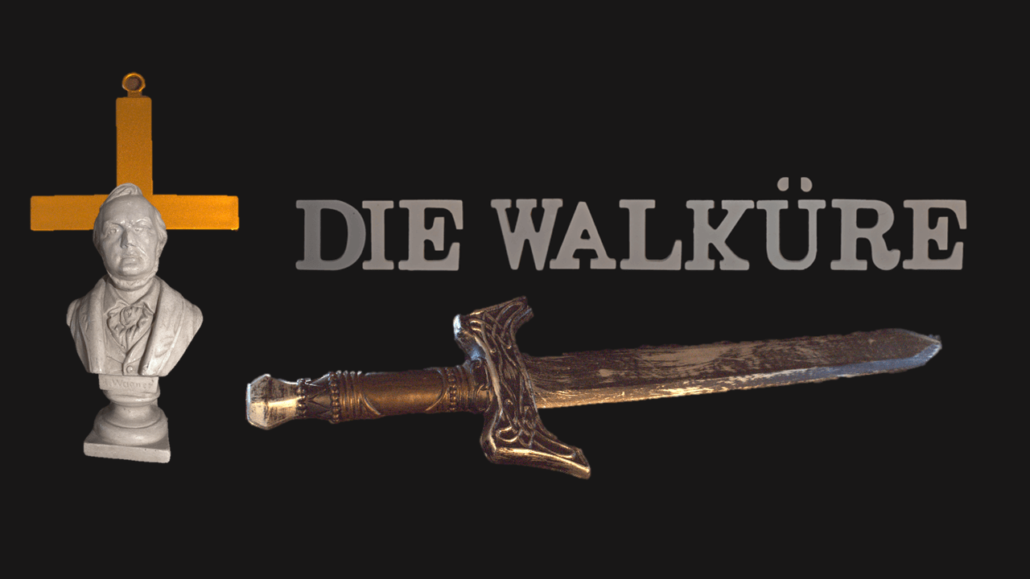
The online opera guide about DIE WALKÜRE
Interesting facts and great audio excerpts about Richard Wagner’s DIE WALKÜREN. Highlights are «ein Schwert verhiess mir der Vater» with Jon Vickers and «Deines Auges Glut…Nothung !» with Lauritz Melchior and Lotte Lehmann.
OVERVIEW & QUICK ACCESS
Content
♪ Synopsis
♪ Act I (In Hounding house)
♪ Act II (Duel-Scene)
♪ Act III (Ride of the walkyries, Farewell-scene)
Highlights
♪ Nothung (Sword-Scene)
♪ Winterstürme wichen dem Wonnemond
♪ Ritt der Walküren (Ride of the Valkyries)
♪ Leb wohl, du kühnes herrliches Kind (Finale)
ROLES & SYNOPSIS OF DIE WALKÜRE IN 4 MINUTES
The Interpretation & much more informations
In the overall portrait to the ring I present the different approaches to the interpretation of the work. To read them, click on the link below. Moreover you will find there much more Information about history, interpretations, theory of leitmotifs etc.
Link to the Portrait to “The ring of the Nibelung”
Three great highlights of the Ring
In the Valkyrie we experience threee of the highlights of the Ring which are among the greatest that the opera has produced:
- The ecstatic love scene of the siblings Siegmund and Sieglinde in which they recognize themselves as destined for each other, and they beget their son Siegfried.
- The beginning of the “Incarnation” of Brünnhilde and the farewell of Siegmund.
- Wotan’s deeply moving farewell to his favourite daughter Brünnhilde.
Great Wagner Singers
This opera portrait focuses on the great Wagner singer of the recording history. Lauritz Melchior, for example, who went down in history as the Wagner heroic tenor. Or the three great Brünnhildes and Sieglindes: Lili Lehmann, Kirsten Flagstadt and Birgit Nilsson, who each determined their years and decades with their role portraits. Or Max Lorenz, who was perhaps the first German Wagner heroic tenor and whose work was closely ambivalently linked to the rise of the Third Reich.
What happened so far
Preliminary events
Synopsis of Rheingold
Why did Wotan father Siegmund and Sieglinde?
This story is not staged in either the Rheingold or the Walküre, so an explanation
Wotan must get the ring back. But he cannot snatch it from Fafner. This must be done by someone “free of contracts”. In plain language: someone has to do it, where no traces can be traced back to Wotan. Under no circumstances should Wotan be considered the author, because Wotan’s power is based on contracts. If he cheated Fafner, it would be the end of Wotan. Siegmund is Wotan’s plan for a “perfect crime”.
DIE WALKÜRE ACT I
The ouverture of Die Walküre
The first act of Die Walküren is one of the greatest pieces of music theatre ever written. It is an intense and emotional music with thrilling scenes and great orchestral and vocal parts. To start, we listen to the ouverture.
Synopsis: Siegmund, wounded and bleeding, desperately seeks shelter in a stormy night.
Wagner dedicated the prelude to Mathilde Wesendonck. He noted in the autograph “G.S.M. - Blessed be Mathilde (Gesegnet Sei Mathilde)”. Wesendonck was his Isolde of the Zurich years. Read more about this famous relationship in the Opera Portrait to the opera Siegfried.
Wagner’s music quickly leads the opera house’s auditors into to a tense, dramatic atmosphere. Hear two great interpretations with Erich Leinsdorf and Wilhelm Furtwängler.
Ouvertüre (1) - Leinsdorf / LSO
Ouvertüre (2) - Furtwängler / Wiener Philharmoniker
Wes Herd dies auch sei
Synopsis: Siegmund has reached the protective place and meets Sieglinde.
The music becomes suddenly more quiet and lyrical. We already hear many wonderful leitmotifs in the orchestra like the sibling love motive.
Short excerpt “Sibling Love Motif”
Wes Herd dies auch sei - Lehmann / Melchior/ Walter
Lotte Lehmann – voice of sensual beauty
Synopsis: Hunding comes home and wants to hear Siegmund’s story.
With the entrance of Hunding the magical atmosphere is swept away. With broad staccati the Hunding motive sounds.
Musical quote “Hunding Motif”
Synopsis: Siegmund tells that one day when returned home, he found his mother killed, his home burned, and his twin sister had disappeared. Later he learned that his sister was being forced into a marriage she did not want. Siegmund tried to defend her. Now Hunding recognizes Siegmund as an old enemy. Traditionally he grants Siegmund the right to stay for the night but challenges him to a duel for next morning. Sieglinde gives Hunding a sleeping drug and shows Siegmund a sword stuck in a tree. Wotan had pushed it in and declared that it will belong to whoever was strong enough to pull it out.
In this Walküren Portrait, you will hear great Wagner heroines from different ages. According to many experts, perhaps the greatest was Lotte Lehmann. Like Maria Callas, she was technically not the best singer, but combined a voice of sensual beauty with great expression. «A similarly nuanced, subtle singing (of Sieglinde) never existed « (Fischer, Great voices). Form your own opinion and listen the audio example «Der Männer Sippe»!
Der Männer Sippe (1) - Lehmann / Melchior / Walter
Hear another Interpretation by Kirsten Flagstadt. Another great Wagner Soprano of the past.
Der Männer Sippe sass hier im Saal (2) - Flagstadt / Knappertsbusch
Wagner’s famous Tenor Aria - Winterstürme wichen dem Wonnemond
Synopsis: Siegmund and Sieglinde realize that they are siblings.
Franz Völker - the first German Heldentenor
Next you will hear Franz Völker who was one of the greatest Lohengrin and Siegmund of the century. Franz Völker (1899-1965) combined the voice power of a Heldentenor with a lyric singing culture. His biography is closely linked to the rise of the Third Reich. His biography of these years was ambivalent On the one hand he looked like the prototype of the Nordic hero, which together with his great voice made him a darling of the public. He was Hitler’s favourite tenor in the years 1933-1940, when the Führer visited Bayreuth every year and enjoyed its protection. He also needed this, because his private life offered considerable opportunities for attack. He was married to a woman with Jewish roots. He defended her until the end of the Nazi period and she survived the Nazi years. That would have been enough for a performance ban, but Völker was also convicted of homosexual acts in 1938, which was a criminal offense in the Third Reich. Hitler’s personal protection protected him from a performance ban.
Winterstürme wichen dem Wonnemond (2) - Völker
Placido Domingo also had Siegmund in his repertoire. This all-rounder has also surprised many sceptics with this beautiful Siegmund interpretation.
Winterstürme wichen dem Wonnemond (3) - Domingo
The «Wagner tenor» by the example of Jonas Kaufmann
Finally a wonderful interpretation by Jonas Kaufmann. You can hear and read more about him in the next section..
Winterstürme wichen dem Wonnemond (4) - Kaufmann
Wagner’s «Heldentenor»-Roles require a tenor voice with radiant power in the dramatic Fach. Accordingly, the voice must be heared over a large orchestra. With Siegmund Richard Wagner has written in the Walküre a role for this Fach. . I would like to start with Jonas Kaufmann, a great tenor of our years. It is interesting how he himself sees this role: “Wagner operas are populated by heroes: Siegfried, Tristan, Lohengrin. Today we are no longer interested in the flawless of the hero’s image, but in the broken aspect. A Siegmund, the epitome of the warrior and warrior, is simply at the end when he appears in the Walküre in front of Hunding’s hut. When he then suddenly becomes so soft, languishes and tells of the women: wonderful. Wagner has always been interested in the human being in his hero figures. (Source: Die Zeit, 2013). Hear Jonas Kaufmann in two scenes:
Synopsis: Wotan had pushed it the sword in the tree and declared that it will belong to the one who is strong enough to pull it out. Siegmund succeeds and calls the sword Nothung. You can hear this very dramatic passage in a great filmed opera house performance.
Siegmund heiss ich, Siegmund bin ich - Kaufmann
Synopsis: Siegmund has succeeded to pull the sword out. They unite and father a child, which later is named Siegfried from the family of the Wälse. (Wälsenblut).
Hear this scene with Jonas Kaufmann.
Wälse - Kaufmann
Mario del Monaco, pure force of nature
You can hear the sword-scene «Ein Schwert versprach mir den Vater» in two versions. One is by Mario del Monaco (1915-1982) a tenor with a brilliant, metallic voice - the tenor with perhaps the largest voice volume of any Italian tenor in recording history. I promise you: you are going to hear the pure power of nature.
Ein Schwert verhiess mir der Vater (1) - del Monaco
The other recordings of this piece are by Franz Völker (1899-1965)
Ein Schwert verhiess mir der Vater (2) - Völker
and a third version from Jon Vickers.
Ein Schwert verhiess mir der Vater (3) - Vickers/Karajan
Lauritz Melchior – the greatest Wagner Tenor of all times
There is one singer who outshines all other tenors in the male leading role of Siegmund: Lauritz Melchior (1899-1973). If you have never heard him before, get an acoustic impression of his voice with the piece «Wälse», a document famous in recording history where he sings Wälse calls more often with 15 or more seconds of sound duration! According to many experts, «Never before has there been such a powerful tenor voice, with a dark timbre and at the same time so brilliant, and to this day he has found no successor» (Scott).
Wääääääääälse! - Melchior
«Never before has there been such a powerful tenor voice, with a dark timbre and at the same time so brilliant, and to this day he has found no successor» (Scott). Listen to Lauritz Melchior in the sword-scene :
Deines Auges Glut…Nothung - Melchior / Lehmann
Scandal
The scene of Siegfried’s procreation by the two siblings was shocking for the visitors of the opera house at that time. Wagner has broken two taboos in this opera: incest and adultery. For him the act or a scandalization was not the main focus. What mattered to him was that with Siegfried, a “truebred” hero would be created.
DIE WALKÜRE ACT II
Birgit Nilsson - a true Wagner-Soprano
Synopsis: In the realm of the gods: Wotan has ordered Brünnhilde, one of his daughters, the Valkyries, to protect Siegmund because he has intended Siegmund to conquer the ring of the Nibelungen. But his wife Fricka asks Wotan to support Hunding because Wotan had conceived Siegmund with another woman. Deeply saddened, he orders Brünnhilde to give the victory in the duel to Hunding.
I do not want to embezzle the famous Birgit Nilsson in the role of Sieglinde. Birgit Nilsson was a gifted Wagner singer and famous for her «vocal power». She was the dominant Wagnerian “dramatic soprano” of the post-war period and thus the successor of Kirsten Flagstadt (you can read more about her further down), even if Kirsten Flagstadt has to be rated a little higher. Listen to the Nilsson «Nun zäume dein Ross, reisige Maid».
Nun zäume dein Ross, reisige Maid - London / Nilsson / Leinsdorf
Siegmund! Sieh auf mich! - Brünhilde’s and Siegmund’s Duett
Synopsis: Siegmund and Sieglinde are on the run. Brünhilde announces Siegmund that he will not survive the fight with Hunding. As a reward she promises him with his death a move into Walhall to his father Wotan and his sisters the Valkyries. But when Siegmund learns that Sieglinde will not be with him and must continue to live, he explains without beating about the bush that in this case he is not even thinking of following Brünnhilde to Valhalla, but rather of going to hell, even wanting to kill his beloved Sieglinde himself if necessary, rather than part with her.
By the way, this name comes from “Wal” (Old High German for war) and “Kür” (free choice), those who choose the art of war as their destiny and live in Walhall.
Sieh auf mich - Nilsson / King
Synopsis: Brünnhilde disobeys Wotan and promises to help Siegmund in battle. Wotan has to destroy Siegmund’s sword in battle and Hunding stabs Siegmund.
The Ride of the Vakyiries and Kirsten Flagstadt
Synopsis: Brünhilde and Sieglinde have fled to Walhall to find help with Brünhilde’s sister Valkyries.
By the way, the name of the Valkyries comes from “Wal” (Old High German for war) and “Kür” (free choice), those who choose the art of war as their destiny and live in Walhall.
In the ride of the Valkyries (“Hojotohe”) you experience Kirsten Flagstadt in an absolutely worth seeing and hearing film recording.
In the first act you met Lotte Lehmann as Sieglinde. In this second part, you will hear more legendary Wagner heroines which often are called «Hochdramatische», Soprano from the highly dramatic Fach. Kirsten Flagstadt was a famous Wagner singer. Her voice was full and strong and at the same time supple and brilliant. «It is true that the conductor of her debut at the Met 1935 dropped his baton in amazement and the singer of Siegmund missed his cue after the first notes of this singer from Oslo, who was completely unknown in America. New York had experienced the most important Wagner interpreter in the decades before, but Kirsten Flagstadt achieved a new standard of popularity for herself and the Wagner repertoire, so that there were critics who divided the American Wagner care into the age «before and after Kirsten» (Fischer, Grosse Stimmen).
Hojotohe (1) - Flagstadt
Here the Ryde of the Valkyries:
Ritt der Walküren - Leinsdorf
Frida Leider
You can hear another great Wagner voice in the Valkyries ride: Frida Leider. She formed a dream duo together with Lauritz Melchior in many Wagner opera performances in many opera houses across the world.
Hojotohe (2) - Leider
DIE WALKÜRE ACT III
Wotan’s Punishment of Brünnhilde
Synopsis: Brünnhilde disobeyed Wotan’s orders and she submits to Wotan’s punishment. She loses gods status and is put to sleep. So that only a hero can get her, Wotan accepts that Loge will put a fire around the sleeping place that only a hero can break through.
Zauberfest bezähmt dein Schlaf - Vickers / Brouwenstjn
The Walküre’s great finale
Synopsis: Wotan says deeply moved goodbye to his favourite daughter.
In «Die Walküren», you will also find one of the great final scenes of opera history («Leb wohl du kühnes herrliches Kind»). Listen to how Wotan bids Brünnhilde his farewell with tender emotion and how the music dissolves into an ecstatic ending. Goose bumps guaranteed in the recording with George London under the great Erich Leinsdorf.
Among other things we hear splendid leitmotifs in it. To the words “He who fears the tip of my spear, never pass through the fire” the Siegfried theme is prophetically heard by the brass (this appears in the longer example “Leb wohl du kühnes herrliches Kind” at 2:18 and is then quoted in a supernatural way in the cellos and basses from 9:18 for a long time).
Short Quote of the Siegfried Motif
the second is Wotan’s paternal love motif for Brünhilde (in the longer extract 2:55)
Short Quote of Wotan’ss love Motif
Leb wohl du kühnes herrliches Kind - London / Leinsdorf
For aficionados: this passage is available in another version with the Ukrainian bassist Alexander Kipnis (1891-1978), who was one of the greatest bassists of the century. «If today one asks a music-loving opera goer about the greatest bassist of this century, the answer will probably be Fyodor Schaljapin; the connoisseur will want to distinguish himself from him by dropping the far less known name Alexander Kipnis. Connoisseurs are not always right, but in this case, the rightness of this judgement will not be denied« (Fischer, «Great Voices»).
Leb wohl du kühnes herrliches Kind - Kipnis
Recording recommendation
EMI with Lauritz Melchior and Lotte Lehmann under the direction of Bruno Walter and the Vienna Philharmonic. There is only the first act with this cast. From the complete recordings, I recommend the following:
DECCA with Jon Vickers, Brigit Nilsson and George London under the direction of Erich Leinsdorf and the London Symphony Orchestra.
Peter Lutz, opera-inside, the online opera guide to DIE WALKÜRE by Richard Wagner
This post is also available in: German


Leave a Reply
Want to join the discussion?Feel free to contribute!